Events
2025
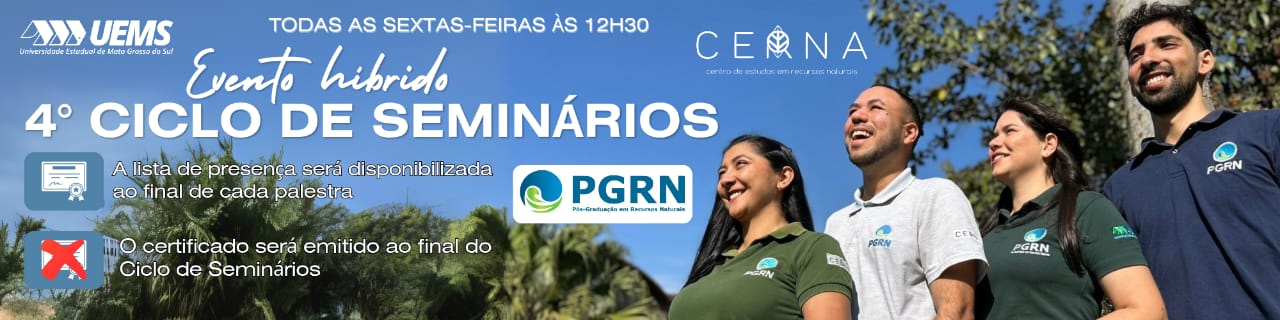
Seminar Cycle Schedule: CLICK HERE
Mini-course: "Use of Remotely Piloted Aircraft (RPA) (Drone) for Environmental Assessment"
Instructor: Prof. Dr. Etenaldo Felipe Santiago and Franck Centurião Fleitas
Start: September 2, 2025
End: September 9, 2025
Course Hours: 12 hours
Format:
In-person classes at the Ecology Laboratory-LE/CERNA (September 2nd and 9th - 8:00 AM to 12:00 PM and September 5th - 1:30 PM to 5:30 PM)
Vacancies: 8
Target Audience: PGRN/CERNA interns
Free registration
(Contact the instructor to check availability and for more information)
Contact:
Etenaldo (67) 99958-1460 and Franck (67) 98142-4978
More information: CLICK HERE
Course: "Introduction to 3D Printing for Prototyping in Research"
Instructor: Msgr. Paulo Sidnei Stringhini Júnior
Start Date: December 2, 2025
End Date: December 10, 2025
Total Hours: 20 hours
Format:
In-person classes in classrooms and laboratories from December 2 to 5 (1:30 PM to 5:30 PM) and on December 10 (8:30 AM to 12:30 PM)
Seats: 10
Free registration
(Contact the instructor to check availability and for more information)
Contact:
paulostringhini@gmail.com
(67) 98473-0638
More information: : CLICK HERE
Course: "Introduction to QGIS, production of environmental maps and use of drones in research"
Instructor: PhD. Jefferson Matheus Barros Ozório
Start: 06/09/2025 End: 06/13/2025
Workload: 40 hours
Format:
- classes in a virtual classroom (Google Meet) from 7:00 pm to 10:00 pm
- practical field class in Dourados/MS
Vacancies: 20
Registration: R$ 100.00 (to be paid directly to the instructor)
(contact the lecturer to check availability and for details on payment)
Contact:
(67) 99715-2338
Lecture: "Africa and Brazil: academic experiences, interculturality and the value of Africa Day"
Speakers: Me. José N'Diba Imbandú and Me. Omar Aweis Ali (PGRN PhD students)
Mediator: Prof. Dr. Sidnei Eduardo Lima Junior
Interpreter (English/Portuguese): Juliana Sussi
Date and time: 05/23/2025, at 8:30 a.m.
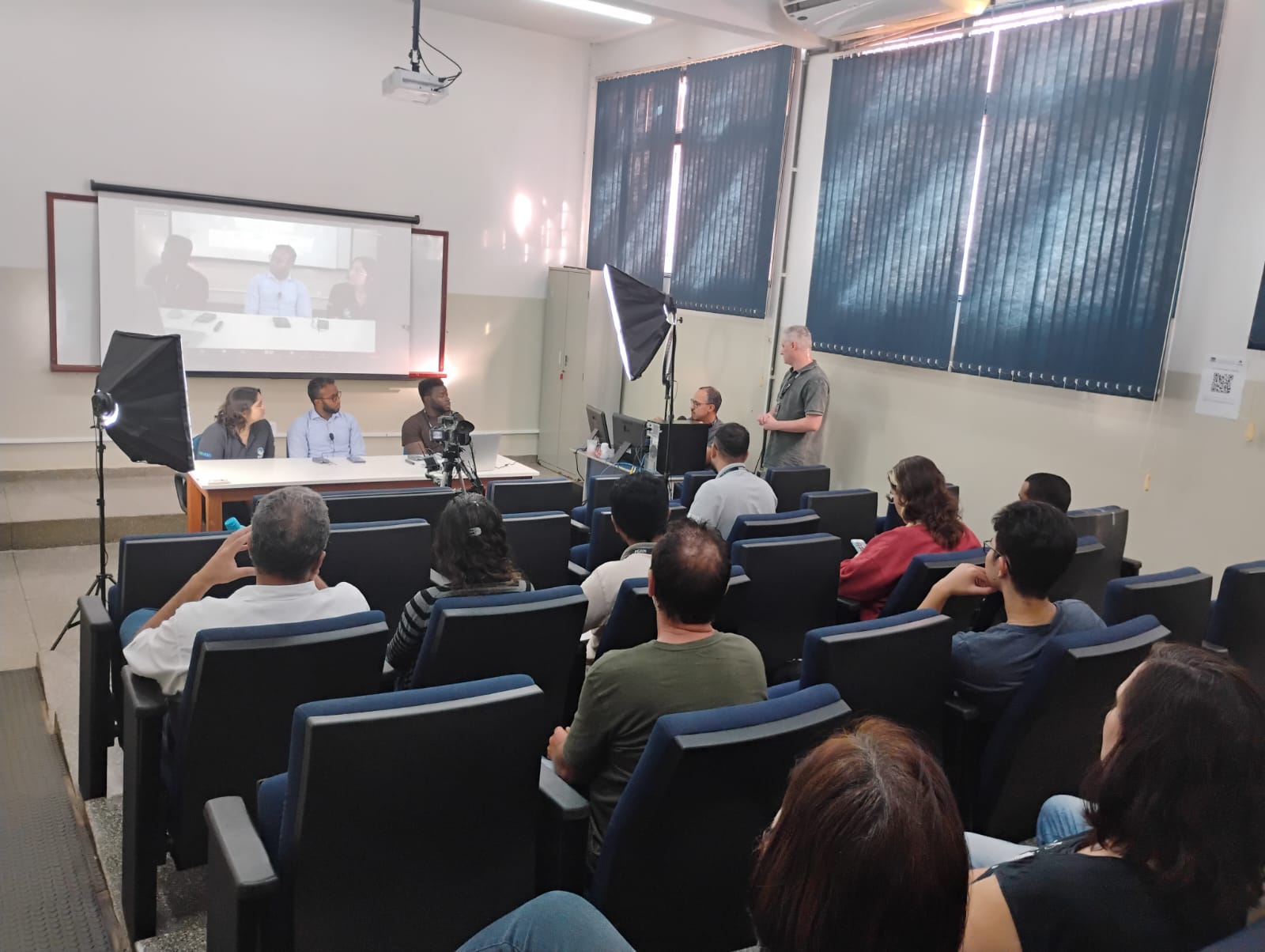
In this lecture, doctoral students José and Omar shared their experiences as African students at the State University of Mato Grosso do Sul (UEMS), addressing the challenges, learnings and contributions in the academic and cultural context. The objective was to promote the recognition of African diversity, reflect on the African presence in Brazilian universities and celebrate Africa Day from a lived perspective.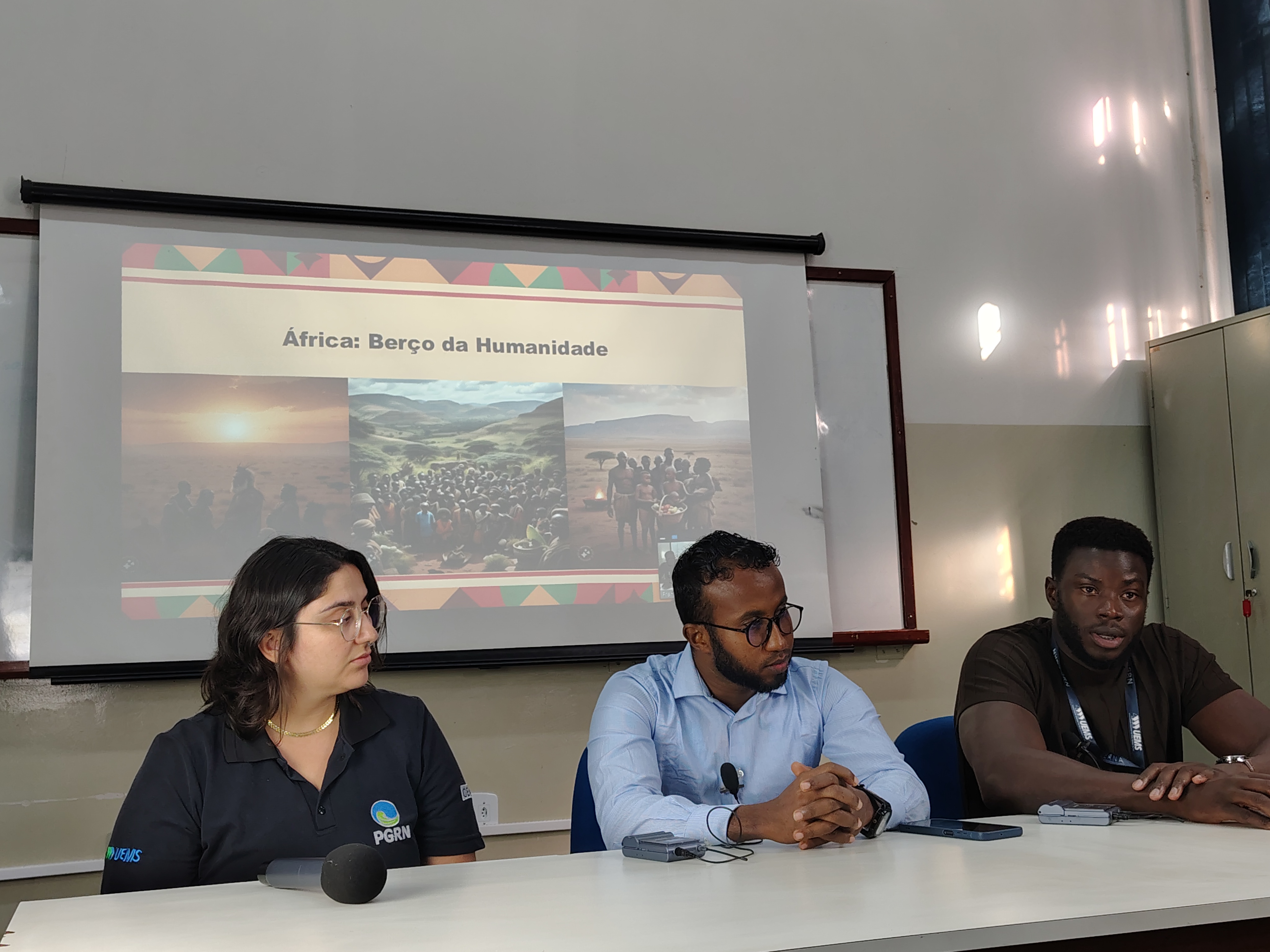
2024

Seminar Cycle Schedule: CLICK HERE
1st Lecture Series in Forensic Sciences
The Postgraduate Program in Natural Resources (PGRN) at UEMS has several areas and different student and faculty profiles, which allows for interdisciplinary research. One of the fruits of this interdisciplinary perspective is the “1st Lecture Series in Forensic Sciences” to be held at the UEMS University Unit in Dourados in May, on the 15th, 16th, 22nd from 1 pm to 5 pm and on the 23rd from 1 pm to 7 pm with lectures and mini-courses.
Registrations can be made at this link.
The event will address several topics in the area by professionals with different backgrounds who work in the Mato Grosso do Sul Scientific Police. According to Claudia Cardoso, the event coordinator, “criminal experts participate in the investigation of criminal occurrences and use their scientific knowledge to produce evidence of criminal acts. They collect traces at crime scenes that can be analyzed in laboratories or compared with other traces. These traces can be biological, physical or chemical in nature.”
Guido Vieira Gomes, a forensic expert for the Mato Grosso do Sul Scientific Police and a PhD student at the PGRN, emphasizes that “professionals from several areas can work as criminal experts, and a degree in at least one is required, such as medicine, dentistry, biology, accounting, physics, chemistry, pharmacy, biomedicine or engineering. The combination of these professionals from different areas of knowledge in the analysis of a given fact will result in a greater chance of a positive result in the context of a criminal investigation.” Check out the schedule at this link.
 |  |  |
 |
2023
Promoting human, social, scientific and technological development based on research on natural resources November 27-30 and December 1, 2023.
Schedule and information: https://www.uems.br/eventos/scrn

2nd Semester/2023
The 2nd PGRN/CERNA Seminar Cycle will have a continuous program throughout the second semester of 2023, and the presentations will always take place on Fridays, from 12:30 pm to 1:30 pm, in the Central Amphitheater of Block A of UEMS-Dourados, with live broadcast on the CERNA channel on YouTube (https://www.youtube.com/c/cernauemsdourados). The entire academic community of the University City of Dourados is invited. In this 2nd Seminar Cycle, the team of professors/researchers intends to present their recent studies that are resonating in the scientific community, with themes involving Natural Resources. With this initiative, PGRN/CERNA hopes to demonstrate to the academic community the importance of doing science, motivating students to contribute to studies and develop research projects with the team.
- Playlist of lectures from the 2nd PGRN/CERNA Seminar Cycle
SCHEDULE
August

Dr. Claudio Yamamoto Morassuti holds a degree in Physics from the State University of Mato Grosso do Sul (2013), a master's degree (2016) and a PhD in Environmental Sciences (2020) in the Postgraduate Program in Natural Resources from the State University of Mato Grosso do Sul Campus of Dourados-MS and a Post-doctorate in Materials Science from the Federal University of Mato Grosso do Sul - UFMS (2022). He is currently a member of the Optical and Photothermal Spectroscopy Group - UEMS and the Optics and Photonics Group - UFMS and a PCI researcher at the Renato Archer Information Technology Center, Campinas - SP, where he is a member of the Biofabrication Group.
 |  |  |
 Dr. Ana Kely Rufino Souza has a degree in Physics from the State University of Mato Grosso do Sul (2012), a master's degree (2017) and a doctorate (2021) in the Postgraduate Program in Natural Resources from the State University of Mato Grosso do Sul, Dourados-MS Campus. She was a PCI researcher at the National Institute for Space Research - INPE in São José dos Campos - SP, working on projects to obtain new materials aiming at improving the solar telescope of the GSST mission. She is currently a PCI researcher at the Renato Archer Information Technology Center, Campinas - SP, where she develops a project in the area of Photonics and Energy - Photovoltaic Solar Energy.
 |  |  |

Dr. Vinicius de Oliveira Ribeiro holds a degree in Environmental Engineering from the Federal University of Mato Grosso do Sul (2006), a master's degree (2011) and a doctorate (2013) in the Postgraduate Program in Environmental Technologies from the Federal University of Mato Grosso do Sul. He was an Environmental Inspector at IMASUL/SEMAC-MS (2006 - 2007), Design Engineer and Sewage Project Manager at the Sanitation Company of MS - SANESUL (2007 - 2013) and Professor at the Institute of Science and Technology of Mato Grosso- IFMT (2013 - 2015). As an Effective Counselor of CREA/MS (2015-2021), he was Vice-President, and coordinated the Environment Committee, the Education and Professional Attribution Committee (CEAP) and the Professional Ethics Committee. He is currently linked to the Environmental and Sanitary Engineering course and the Postgraduate Program in Natural Resources (PGRN), in Dourados/MS. He is also the coordinator of the Sanitation and Geotechnologies Modeling Laboratory - LASANGE/UEMS. He has acted as an ad hoc expert for the MPMS, ad hoc consultant for CNPq, CAPES, FAP's and several scientific journals. He has experience in the area of Environmental Sanitary Engineering and Geotechnologies, with a focus on the fields of Drainage and Wastewater Treatment (Domestic and Industrial), Basic Sanitation, Free GIS and Applied Environmental Remote Sensing.
 |  |  |

Prof. Dr. Nicolaz Bordan Aranda holds a degree in Physics from the State University of Mato Grosso do Sul (2011), a master's degree (2013) and a doctorate (2018) from the State University of Maringá. He has worked on the following topics: preparation of glassy materials and characterization of materials using photothermal techniques, such as optical absorption, luminescence and thermal lens.
 |  |  |
September

Prof. Dr. Paulo Souza da Silva holds a Bachelor's and Full Degree in Physics from the Federal University of Rio de Janeiro (1991 and 1995), a Master's degree (1994) and a PhD (1999) from the Federal University of Rio de Janeiro. He has worked on the following subjects: Luminescence of Fe3+ and Cr3+ in Oxide and Fluoride Matrices. He has been an Adjunct Professor at the Federal University of Rio de Janeiro since 1999. He coordinates the Popciência project, funded by Finep, Itinerant Astronomy and Ethnoastronomy of the Guarani Indians of the Greater Dourados Region/MS, both funded by CNPq.
- THE SKY OF THE INDIANS OF DOURADOS-MS - Book (PDF)
 |  |  |

Prof. Dr. Daniela Manfroi Rodrigues holds a degree in Chemistry from the State University of Mato Grosso do Sul (2006), a master's degree in Materials Science from the State University of São Paulo Júlio de Mesquita Filho (2009) and a PhD in Chemistry from the Chemistry Institute of Araraquara (2014). She has worked as coordinator of the Center for the Development of Chemical Technologies (CDTEQ - UEMS/Naviraí), where she develops institutional projects and advises students, in addition to also working in university extension, participating in and organizing events, mainly in Naviraí. Adjunct Professor at the State University of Mato Grosso do Sul, Naviraí Unit, where she develops her teaching activities, working mainly in the disciplines of the area of Physical Chemistry. He has experience in research in the area of Condensed State Chemistry, working with the Chemical Synthesis of materials (Sol-Gel, Polymeric Precursors and Hydrothermal) and also experience in the thermal, morphological, structural, optical, etc. characterization of materials. He develops research projects focusing on the hydrothermal synthesis of multifunctional nanostructured materials, applying mainly to the removal of contaminants in water.
 |  |  |

Dr. Montcharles Silva Pontes holds a degree in Biological Sciences from the State University of Mato Grosso do Sul (2016), a master's and a doctorate in Natural Resources from the State University of Mato Grosso do Sul (2019 and 2022). He has worked as a research project coordinator in the Technological Innovation Program / PIPE - FAPESP. He is currently a principal researcher at AgrÓptica Instrumentação e Serviços Ltda (São Carlos-SP). He was a Human Resources Fixation and Training (SET C) scholarship holder at the National System of Photonics Laboratories Sisfóton of MCTI / CNPq (2022-2023). He has scientific collaboration with several research groups from different national institutions (UEMS, UFMS, UNESP, UFC, USP, UFMG, among others) and international institutions from different countries (Germany, UK, Switzerland, among others). He has experience in the area of Plant Physiology and Biochemistry with emphasis on Photochemistry and Biophotonics of Photosynthesis, Computational Biology and Nanotechnology. He works mainly with optical studies of photosynthesis, nanopesticides and nano-enabled systems, through the development of organic, inorganic and hybrid nanoparticles and nanocarrier systems. He is skilled in in vivo, in vitro and in silico nanotoxicological tests. His work involves analytical techniques such as: optical spectroscopy (steady-state and time-resolved), atomic force microscopy (AFM), electron microscopy (SEM/TEM), dynamic light scattering, enzymatic and photochemical/photophysical tests in photosynthesis. He is currently part of the editorial board of the journal Frontiers in Nanotechnology (Frontiers) in the area of Environmental Nanotechnology, guest editor of Plant NanoBiology (Elsevier) and is a member of the International Society of Photosynthesis Research (ISPR) and the Brazilian Society of Microscopy and Microanalysis (SBMM).
 |  |  |
 Prof. Dr. Sandro Márcio Lima Sandro holds a degree in Physics from the State University of Maringá (1996), a master's and a doctorate in Applied Physics from the Institute of Physics of São Carlos at the University of São Paulo (1999 and 2003). He served as Pro-Rector of Administration and Planning at UEMS between 2010 and 2012. He was also Coordinator of the Postgraduate Program in Natural Resources at UEMS between 2010-2013, President of the Structuring Teaching Committee of the Physics Engineering Course between 2013 and 2015, and member of the Superior Council of the Foundation for Support of Development, Education, Science and Technology of Mato Grosso do Sul (Fundect-MS) between 2007-2014. He is currently an Assistant Professor IV at the State University of Mato Grosso do Sul (UEMS), Dourados, MS, and Coordinator of the Postgraduate Programs of Chamber I (Environment and Agrarian Sciences) of the Interdisciplinary Area of CAPES, and is also the Coordinator of the Center for Studies in Natural Resources (CERNA) of UEMS. During his doctorate, he did a sandwich internship at the University of Southampton, in Southampton, England. He did postdoctoral research at IFSC-USP from February 2003 to February 2004. He has experience in the area of Applied Physics, with emphasis on Thermal and Optical Properties of Condensed Matter.
 |  |  |
October
 Dr. Ana Paula Lemke holds a bachelor's degree in Environmental Management from the Federal University of Grande Dourados (2010), and a master's and doctorate in Natural Resources from the State University of Mato Grosso do Sul (2013 and 2018). She worked as a substitute teacher in the Environmental Management course at the Federal University of Grande Dourados between 2016 and 2018 and also as a professor at the State University of Mato Grosso do Sul, Coxim university unit between 2019 and 2021. She is currently a collaborating professor of the MBA in Environmental Management at the Federal University of Grande Dourados, professor of the Environmental Management Technology course at the State University of Mato Grosso do Sul, Mundo Novo university unit. She has experience in the area of surface water monitoring, geotechnologies applied to natural environments, ecology of communities in streams and environmental indicators.
 |  |  |
 Prof. Dr. Margareth Batistote holds a degree in Biology from Dom Bosco Catholic University (1988), a Master's degree in Microbiology from Londrina State University (1998), and a PhD (2006) and Post-Doctorate (2007) in Biotechnology from São Paulo State University Júlio de Mesquita Filho - Chemistry Institute. She worked as a professor at the State University of Mato Grosso do Sul, in the university units of Glória de Dourados and Dourados. She has experience in the area of Microbiology, with an emphasis on Protozoa, bacteria and yeasts, working mainly on the following topics: trypanosomatids, physiological characterization, yeasts, carbon source, nitrogen source, metabolism and fermentation processes.
 |  |  |
November
 Prof. Dr. Luis Humberto da Cunha Andrade holds a degree in Physics from the University of São Paulo (1996), a Master's degree (1998) and a PhD (2006) in Physics from the University of São Paulo, a sandwich doctorate from the Université Claude Bernard Lyon 1-UCBL in Lyon - France (2002) and a Post-doctorate from the Université Lyon 1 - UCBL in Lyon, France (2007). He was the coordinator of the Postgraduate Program in Natural Resources - PGRN at the State University of Mato Grosso do Sul - UEMS and of the Physics Course at UEMS. He worked on the implementation of the Physical Engineering Course and was president of the course implementation committee. He is an adjunct professor level IV at the State University of Mato Grosso do Sul - UEMS. He has experience in the area of Physics, with experience in the synthesis of crystals and glasses and the optical characterization of materials aimed at the development of white light LEDs, hybrid solar converters, luminescent temperature sensors, optical dispersion of transparent materials in the UV-Vis region and characterization of materials by plasma using the LIBS technique.
 |  |  |
 Dr. Jaqueline da Silva Santos holds a degree in Biological Sciences from the Federal University of Piauí (2013), a specialization in Environmental Management (2014), and a Master's and PhD in Natural Resources (Environmental Sciences) from the State University of Mato Grosso do Sul (2015-2021). She is a postdoctoral researcher at the Department of Plant Genetics and Biochemistry - Esalq-USP and Lancaster Environmental Center, Lancaster University. She has experience in botany, mainly in plant physiology, studying the physiological responses of plants exposed to stress conditions, mainly evaluating oxidative stress. In addition, she is interested in plant biochemistry and physiology applied to the understanding of photosynthesis and plant yield. He has experience with chlorophyll fluorescence techniques, gas exchange, ultraviolet and visible spectrophotometry, spectroscopy, electrochemistry, etc., applied to the analysis of biological materials (plants), water and characterization of electrochemical sensors.
 |  |  |

Dr. Felipe de Paula Nogueira Cruz holds a degree in Biomedical Sciences from the University of Mogi das Cruzes, a master's degree in Biosystems from the Federal University of ABC, and a PhD in Biotechnology from the Federal University of São Carlos. Dr. Felipe's main line of research is based on the prospecting of enzymes, biomolecules with antimicrobial activity produced by microbial strains associated with Brazilian medicinal plants. He also works on projects related to the epidemiological surveillance of viral diseases. His latest work at the University of Michigan (2022/2023) was responsible for the detection of SARS-CoV-2 and other viral pathogens in wastewater with the aim of promoting their monitoring in the Southeast region of the state of Michigan. He is currently a professor in the Natural and Physical Sciences Department at Graceland University.
• Term